IIT Guwahati BS in Biomedical Science and Engineering Through IAT 2026: Complete Admission Guide
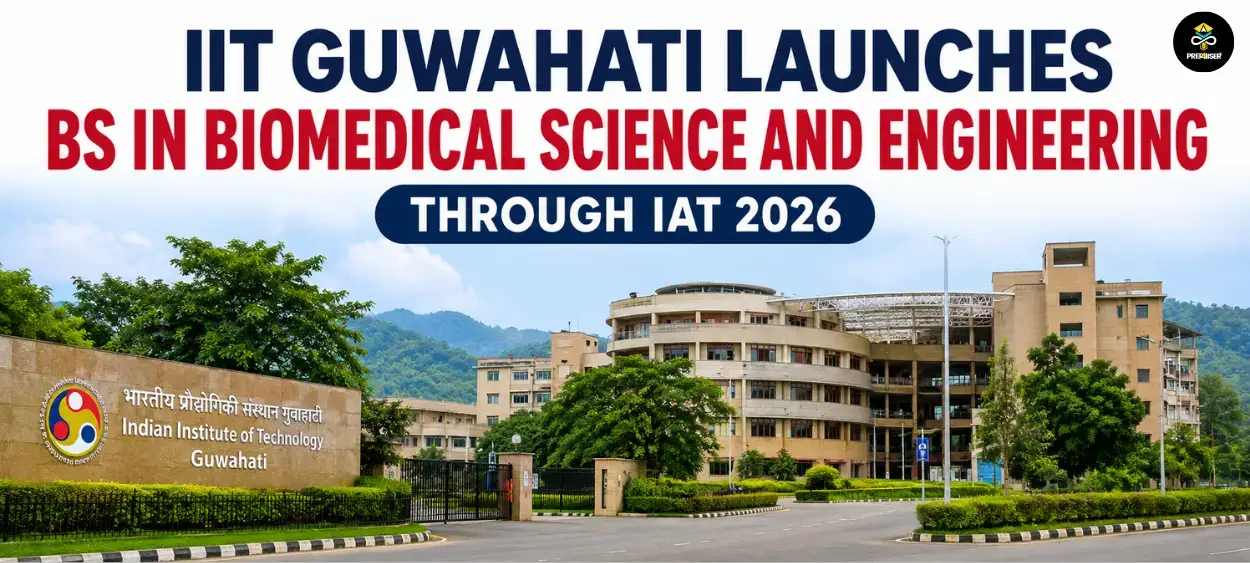
Who This Guide Is For: IAT 2026 aspirants, PCMB students, and science-interested candidates exploring interdisciplinary programmes in biomedical sciences, healthcare technology, and engineering through the IISER Aptitude Test.
Official Source: IIT Guwahati Admissions Portal | IISER IAT 2026
Key Update: This is the first time an IIT is admitting students through IAT, significantly expanding opportunities for IAT aspirants.
In a major development for science aspirants, the Indian Institute of Technology Guwahati has introduced a new 4-Year BS Programme in Biomedical Science and Engineering (BMSE) through IISER Aptitude Test (IAT) 2026.
This is one of the most exciting interdisciplinary programmes introduced for students interested in:
- Healthcare technology
- Biomedical engineering
- Artificial Intelligence in medicine
- Medical devices
- Computational biology
- Future healthcare innovation
The programme is offered through the: Jyoti and Bhupat Mehta School of Health Sciences and Technology at IIT Guwahati.
This new course creates a unique pathway for students who want to combine:
- Biology
- Engineering
- Mathematics
- AI and Computing
- Healthcare sciences
with the ecosystem and reputation of an IIT.
For many IISER and IAT aspirants, this could become one of the most attractive alternatives and opportunities available in 2026.
What is the IIT Guwahati BMSE Programme?
The BS in Biomedical Science and Engineering is a multidisciplinary undergraduate programme designed to train students in:
- Biomedical systems
- Healthcare innovation
- Medical technology
- Engineering design
- AI-enabled healthcare applications
- Biomedical research
Unlike traditional engineering branches, this programme focuses on integrating:
- Medicine
- Biology
- Electronics
- Computer Science
- AI
- Mechanical systems
- Data-driven healthcare
The goal is to prepare students for the future of:
- Smart healthcare
- Medical diagnostics
- Biomedical product innovation
- Research and translational medicine
Programme Type: 4-Year BS Degree (not B.Tech) - research-oriented with strong engineering components. This is a unique degree type that bridges basic sciences and applied engineering.
Why This Programme is Important
The healthcare industry is rapidly evolving because of:
- Artificial Intelligence
- Biomedical imaging
- Digital health platforms
- Robotics
- Wearable technology
- Precision medicine
India currently has very limited undergraduate programmes that genuinely combine:
- Engineering
- Biology
- Clinical exposure
- AI and healthcare innovation
This is where IIT Guwahati's BMSE programme becomes extremely significant.
It aims to produce students capable of working at the intersection of:
- Technology
- Medicine
- Research
- Healthcare entrepreneurship
For students interested in futuristic science careers, this programme could become a major opportunity.
What Makes BMSE Different from Traditional Biomedical Engineering
| Feature | Traditional B.Tech Biomedical Engineering | IIT Guwahati BS BMSE |
|---|---|---|
| Degree Type | B.Tech (Engineering) | BS (Science with Engineering) |
| Clinical Exposure | Limited | Dedicated clinical immersion |
| AI Integration | Optional | Core component |
| Research Focus | Moderate | Strong research orientation |
| Collaboration | Industry-focused | AIIMS and NIPER collaboration |
| Intake | Larger (60-120 seats) | Small (20 seats) |
Admission Through IISER Aptitude Test (IAT) 2026
One of the most important highlights is that admission will happen through: IISER Aptitude Test (IAT) 2026
This means students preparing for:
- IISER admissions
- IISc Bangalore BS
- Research-oriented science programmes
can also apply for this IIT Guwahati programme.
This increases the value of IAT preparation significantly in 2026.
Historic First: This is the first time an IIT has opened its undergraduate admissions through IAT. Previously, IAT was only used for IISERs, IISc Bangalore, and a few other research institutes. IIT Guwahati's decision signals a potential trend of more IITs accepting IAT scores in the future.
Eligibility Criteria for IIT Guwahati BMSE 2026
To apply for the programme, candidates must satisfy the following conditions.
Academic Eligibility
Students must:
- Have appeared in Class 12 for the first time in 2025 or 2026
- Have Physics, Chemistry, Mathematics, and Biology (PCMB) in Class 12
- Score a minimum aggregate of 75 percent in PCBM subjects
- Qualify IISER Aptitude Test (IAT) 2026
Subject Requirement Table
| Subject Required | Status |
|---|---|
| Physics | Mandatory |
| Chemistry | Mandatory |
| Mathematics | Mandatory |
| Biology | Mandatory |
| English | Not Required |
This makes the programme especially suitable for:
- PCMB students
- Science students interested in interdisciplinary careers
- Aspirants looking beyond traditional engineering branches
Who Cannot Apply
- Students with only PCM (without Biology)
- Students with only PCB (without Mathematics)
- Students who appeared for Class 12 before 2025
Important Admission Dates
| Event | Date |
|---|---|
| Application Portal Opens | 09 March 2026 |
| Application Portal Closes | 15 June 2026 |
| IAT 2026 Examination | June 2026 (exact date to be announced) |
| Selection Process | June 2026 |
| Registration of New Students | 21 July 2026 |
| Classes Begin | 23 July 2026 |
Students should regularly check official IIT Guwahati admission portals for updates regarding:
- Shortlisting
- Merit lists
- Selection rounds
- Counseling information
Seat Matrix for IIT Guwahati BMSE 2026
The total intake for the programme is: 20 Seats
Category-Wise Seat Distribution
| Category | Seats |
|---|---|
| OPEN (General) | 8 |
| GEN-EWS | 2 |
| OBC-NCL | 5 |
| SC | 3 |
| ST | 2 |
| Total | 20 |
What Small Intake Means for Applicants
The programme has a relatively small intake, which indicates:
- Higher competition than larger programmes
- Better faculty-to-student interaction
- Stronger research exposure opportunities
- More focused academic mentoring
- Potentially higher cutoff ranks
For context, most IISER BS-MS programmes have 80-120 seats per campus. At 20 seats, BMSE will be significantly more selective.
Curriculum Highlights
The curriculum is designed to combine:
- Science
- Engineering
- Medical applications
- Computational systems
Core Areas Included in the Programme
Mathematics Strong quantitative foundations for biomedical modeling and analysis.
Computer Science and AI Students learn:
- Programming fundamentals
- Data analysis techniques
- AI applications in healthcare
- Biomedical computation and algorithms
Electronics and Electrical Systems Focus on:
- Medical instrumentation
- Biomedical sensors
- Signal processing for healthcare
Mechanical and Design Systems Training includes:
- Prototyping of medical devices
- Biomedical device design
- Engineering design principles
Biomedical Sciences Students study:
- Human physiology
- Biomedical systems
- Clinical concepts
- Health sciences fundamentals
Year-Wise Curriculum Structure (Anticipated)
| Year | Focus Areas |
|---|---|
| Year 1 | Foundational sciences (Physics, Chemistry, Biology, Mathematics) + Basic programming |
| Year 2 | Core biomedical sciences + Electronics fundamentals + Data science |
| Year 3 | AI in healthcare + Medical instrumentation + Design labs |
| Year 4 | Specialization electives + Clinical immersion + Capstone project |
Hands-On Learning Opportunities
One of the strongest features of this programme is practical exposure.
Students will work in:
- Design labs for medical device prototyping
- Biomedical labs for experimental learning
- Prototyping environments for product development
- Clinical interaction programmes with real patients (observation-based)
This bridges the gap between:
- Theoretical learning
- Real-world healthcare applications
Collaboration with AIIMS Guwahati and NIPER Guwahati
A major highlight of the programme is collaboration with:
- AIIMS Guwahati (All India Institute of Medical Sciences)
- NIPER Guwahati (National Institute of Pharmaceutical Education and Research)
This creates opportunities for:
- Clinical exposure to real medical cases
- Medical research collaboration
- Industry and hospital interaction
- Interdisciplinary healthcare innovation
Students will interact with:
- Doctors and clinicians
- Scientists and researchers
- Engineers and technologists
- Biomedical researchers
This level of clinical and research exposure is extremely rare at the undergraduate level in India.
Clinical Immersion Programme
The programme includes a dedicated: Clinical Immersion Component
Students will interact with:
- Surgeons
- Medical experts
- Healthcare professionals
- Hospital administration
This helps students understand:
- Real medical challenges and unmet needs
- Clinical workflows and hospital operations
- Patient-oriented engineering solutions
- Regulatory and ethical considerations
Such exposure is highly valuable for:
- Biomedical innovation
- Medical startup ecosystems
- Translational research
- Healthcare product development
Career Opportunities After This Programme
The healthcare technology sector is one of the fastest-growing industries globally.
Career Path 1: Biomedical Engineering
Working on:
- Medical devices and instruments
- Imaging systems (MRI, CT, Ultrasound)
- Healthcare technologies
- Prosthetics and implants
Career Path 2: AI and Digital Health
Roles involving:
- Healthcare AI and machine learning
- Medical data analytics
- Health data systems and informatics
- Biomedical software development
Career Path 3: Research and Higher Studies
Students can pursue:
- MS in Biomedical Engineering
- MS in Computational Biology
- PhD in Bioengineering
- PhD in Healthcare AI
- Integrated PhD programmes
at top institutions in India (IISc, IITs, AIIMS) or abroad (MIT, Stanford, Johns Hopkins, Imperial College).
Career Path 4: Healthcare Startups and Innovation
The interdisciplinary nature of the programme makes it highly suitable for:
- Health-tech entrepreneurship
- Biomedical product development
- Innovation-driven startups
- Medical device companies
Career Path 5: Regenerative Medicine and Therapeutics
Advanced research opportunities may emerge in:
- Tissue engineering
- Regenerative systems
- Therapeutic technologies
- Stem cell applications
Industry Roles and Salary Expectations
| Role | Typical Entry-Level Salary Range (India) |
|---|---|
| Biomedical Engineer | Rs. 4-8 LPA |
| Healthcare Data Analyst | Rs. 5-10 LPA |
| Medical AI Engineer | Rs. 8-15 LPA |
| Clinical Research Associate | Rs. 4-7 LPA |
| Medical Device Design Engineer | Rs. 5-10 LPA |
Salaries significantly higher for international opportunities or PhD-track research roles.
Why This Programme Could Become Extremely Popular
This programme combines:
- IIT brand value and reputation
- Biomedical engineering fundamentals
- AI and computing integration
- Clinical exposure through AIIMS collaboration
- Research orientation
- Healthcare innovation focus
Very few undergraduate programmes in India currently offer all these components together.
As healthcare technology grows globally, programmes like this are likely to become highly valuable in the future job market.
Factors That Will Drive Demand
- Growing healthcare technology market in India (expected to reach USD 50 billion by 2030)
- Increasing need for professionals who understand both medicine and technology
- Government initiatives like Digital Health Mission and Ayushman Bharat creating healthcare tech jobs
- Limited supply of truly interdisciplinary graduates in India
Is This Better Than Traditional Engineering Branches?
The answer depends on your interests.
This Programme is Ideal for Students Who:
- Love both Biology and Technology equally
- Want interdisciplinary healthcare careers
- Are interested in healthcare innovation and medical devices
- Prefer research-oriented careers over pure software jobs
- Want exposure to AI and computing in medicine
- Dream of working at the intersection of hospitals and technology
Traditional Engineering (CSE, ECE, Mechanical) is Better for Students Who:
- Want conventional software or core engineering placement pathways
- Are not interested in Biology or healthcare
- Prefer established industry pipelines with predictable outcomes
- Want larger peer groups and alumni networks
For students interested in future science and healthcare technologies, BMSE offers exceptional potential.
Should IISER Aspirants Apply for This Programme?
Absolutely.
Students preparing for:
- IISER admissions
- IISc Bangalore BS programmes
- Research-oriented science programmes
should seriously consider this option.
Comparison: IISER BS-MS vs IIT Guwahati BMSE
| Parameter | IISER BS-MS | IIT Guwahati BMSE |
|---|---|---|
| Degree | BS-MS (5 years) | BS (4 years) |
| Focus | Pure Sciences research | Biomedical + Engineering |
| Exit Option | After 4 years (BS) or 5 years (MS) | After 4 years (BS) |
| Clinical Exposure | Minimal to none | Dedicated clinical immersion |
| IIT Brand | No | Yes |
| Research Strength | Exceptional | Growing (with collaborations) |
| Placement Culture | Moderate | Stronger (IIT ecosystem) |
| Best For | Research careers | Industry + Research hybrid |
Key Advantages for IISER Aspirants
This creates:
- More opportunities through the same IAT score
- Access to IIT ecosystem and alumni network
- Exposure to biomedical innovation and clinical settings
- Alternative research-oriented pathways beyond IISERs
- A 4-year degree option (compared to IISER's 5-year BS-MS)
For PCMB students especially, this could become one of the best interdisciplinary opportunities available through IAT 2026.
Application Process for IIT Guwahati BMSE 2026
The application process is completely online.
Step-by-Step Process
- Visit the official IIT Guwahati admission portal
- Register with email ID and phone number
- Fill personal and academic details carefully
- Select the BS in Biomedical Science and Engineering programme
- Enter IAT 2026 application number
- Upload required documents (photograph, signature, Class 10 and 12 marksheets)
- Complete application fee payment
- Submit and download confirmation
Documents Required
- IAT 2026 application number and hall ticket
- Class 10 marksheet (date of birth proof)
- Class 12 marksheet (if available) or provisional certificate
- Category certificate (if applicable)
- Recent passport-size photograph
- Signature
Applicants also need to provide subject-wise Class 12 marks later during admission stages.
Application Fee
| Category | Fee |
|---|---|
| Female / SC / ST / PwD / Transgender | Rs. 800 |
| Other Candidates (General, OBC, EWS) | Rs. 1000 |
Fee is non-refundable under normal circumstances.
Fee Structure
Tuition Fee Per Semester
Rs. 1,00,000 (One Lakh Rupees)
First Semester Total Fee (Approximate)
Approximately: Rs. 1,65,250
Breakdown includes tuition, hostel, mess, and other institute charges.
Second Semester Onwards (Approximate)
Approximately: Rs. 1,42,450
Fee Waivers
SC/ST/PwD students receive tuition fee exemptions as per institute policies.
Need-based financial assistance may also be available through IIT Guwahati's student support programs.
Frequently Asked Questions
Is IIT Guwahati BMSE admission through JEE Advanced?
Can PCM students (without Biology) apply?
What is the duration of the programme?
Is the programme research-oriented or industry-oriented?
Is AI and Computer Science included in the curriculum?
How many seats are available in total?
What IAT score is needed for IIT Guwahati BMSE?
Can I apply for both IISERs and IIT Guwahati BMSE through IAT?
Is hostel accommodation provided?
What is the collaboration with AIIMS Guwahati?
Final Thoughts
The launch of the IIT Guwahati BS in Biomedical Science and Engineering through IAT 2026 is a major development for science aspirants in India.
This programme represents the future of:
- Interdisciplinary science education
- Healthcare technology innovation
- Biomedical engineering
- AI-enabled medicine
For students interested in combining:
- Biology
- Engineering
- Research
- Technology
- Healthcare
this could become one of the most exciting undergraduate opportunities available through IAT.
As healthcare and AI continue transforming the world, programmes like BMSE may play a major role in shaping the next generation of innovators, researchers, and healthcare technologists.
Students preparing for IISER IAT 2026 should definitely keep this programme on their radar.
Important Disclaimer
Note: This guide is prepared by the PREP4IISER editorial team based on official announcements and programme brochures released by IIT Guwahati. Candidates are strongly advised to verify all details, including eligibility, dates, fees, and curriculum, from the official IIT Guwahati admission portal before applying. Programme details are subject to change at the institute's discretion.
Stay Updated with PREP4IISER
PREP4IISER will continue providing:
- IAT 2026 updates and notifications
- IISER counseling guidance and rank analysis
- Admission alerts for new programmes
- Preparation strategies and mock tests
- Important science career opportunities
- Programme comparisons and cutoffs
Stay connected for the latest updates regarding:
- IISER admissions 2026
- IISc Bangalore BS programmes
- IIT Guwahati BMSE
- Research-oriented science programmes in India