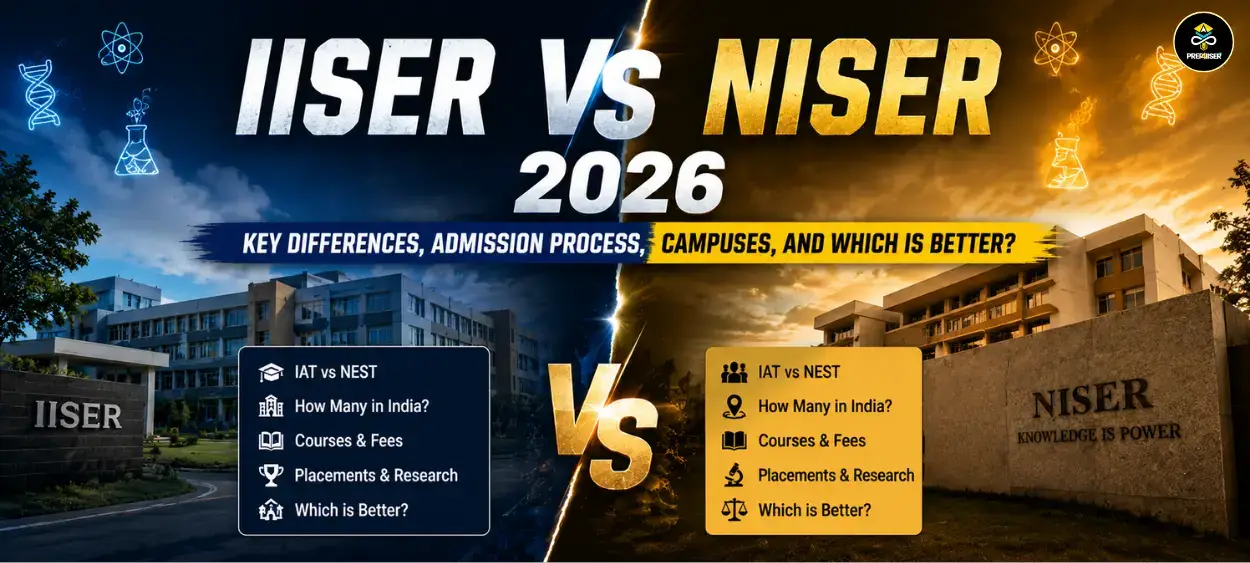
IISER vs NISER 2026: Key Differences, Admission Process, Campuses, and Which Is Better?
Quick Answer: Both IISER and NISER are premier science research institutes funded by the Government of India, offering integrated science degrees. The key differences are in scale (7 IISERs vs 1 NISER), admission exams (IAT vs NEST), and governing bodies (Ministry of Education vs Department of Atomic Energy). Neither is universally "better" the right choice depends on your goals, location preference, and subject interest.
1. What are IISER and NISER?
If you are a science aspirant targeting premier research institutions in India, you have likely come across both IISER and NISER. Here is a concise breakdown of what each one is.
IISER Indian Institutes of Science Education and Research
The Indian Institutes of Science Education and Research (IISERs) were established by the Ministry of Education (then Ministry of Human Resource Development) starting in 2006. They were created to fill a critical gap in India's higher education landscape a place where science education and frontline research happen together, under one roof.
IISERs offer a 5-year BS-MS dual degree in sciences. They are autonomous institutions of national importance, equivalent in status to IITs and IIMs. Admission is primarily through the IISER Aptitude Test (IAT).
NISER National Institute of Science Education and Research
The National Institute of Science Education and Research (NISER) , located in Bhubaneswar, Odisha, was established in 2006 by the Department of Atomic Energy (DAE) , Government of India. Unlike IISERs which are under the Ministry of Education, NISER operates under the DAE which also oversees institutions like BARC, TIFR, and VECC.
NISER offers a 5-year Integrated MSc programme in sciences. Admission is through the National Entrance Screening Test (NEST) . NISER is affiliated with Homi Bhabha National Institute (HBNI) , meaning its degrees carry the prestige of the DAE's research ecosystem.
| Quick Facts | IISER | NISER |
|---|---|---|
| Number of campuses | 7 | 1 |
| Founded | 2006 onwards | 2006 |
| Programme duration | 5 years | 5 years |
| Admission exam | IAT | NEST |
2. Are IISER and NISER the Same?
A very common question and the short answer is no, they are not the same, though they share significant similarities in spirit and purpose.
Both were founded in the same year (2006), both offer 5-year dual-degree science programmes, both emphasise research, and both attract top-performing science students from across India. However, they differ in governance, admission process, affiliating body, campus scale, and departmental strengths.
Think of them as cousins, not twins. Both are elite; both are research-intensive but the paths, structures, and outcomes are distinct enough to matter when making your decision.
3. Key Differences Between IISER and NISER
Here is a snapshot of the most important structural differences:
- Governing ministry: IISERs fall under the Ministry of Education; NISER is under the Department of Atomic Energy (DAE)
- Number of institutes: There are 7 IISERs; there is only 1 NISER
- Admission exam: IISERs use the IISER Aptitude Test (IAT); NISER uses NEST
- Degree name: IISERs award a BS-MS dual degree; NISER awards an Integrated MSc
- Affiliating body: IISERs are autonomous and award their own degrees; NISER is affiliated with HBNI
- Research ecosystem: NISER's DAE affiliation gives students closer ties to nuclear science, BARC, and TIFR; IISERs are broader in scope
- PhD gateway: Both institutions have strong PhD programmes; NISER graduates can more seamlessly enter DAE-funded PhD positions
4. IISER vs NISER: Admission Process (IAT vs NEST)
IISER Admission IAT (IISER Aptitude Test)
Admission to IISERs (for most students) happens through the IISER Aptitude Test (IAT) , conducted jointly by all 7 IISERs once a year, typically in June. The IAT is a computer-based test with 60 questions across 4 subjects: Biology, Chemistry, Mathematics, and Physics.
Eligibility: You must have passed Class 12 with PCM/B and secured at least 60 percent marks (55 percent for SC/ST/PwD).
After the IAT, students are allotted seats through a centralised counselling process where they choose their preferred IISER and subject stream.
PREP4IISER Tip: The IAT tests conceptual understanding, not rote memory. Focus on NCERT plus standard reference books, and practise previous year IAT papers. Use our resources for IAT-style practice questions across all four subjects.
NISER Admission NEST (National Entrance Screening Test)
Admission to NISER is through NEST , a national online entrance exam conducted once a year (usually in June). NEST is also the admission gateway to UM-DAE CEBS (University of Mumbai - Department of Atomic Energy Centre for Excellence in Basic Sciences).
NEST is open to all eligible Class 12 students. The examination consists of four subject sections: Biology, Chemistry, Mathematics, and Physics. Candidates can choose which subject sections to attempt, and the best three subject scores are generally considered for merit calculation. There is no requirement to qualify JEE Main, JEE Advanced, or be a board topper to appear for NEST. Students who satisfy the prescribed Class 12 eligibility criteria can apply directly.
IAT vs NEST: Side-by-Side Comparison
| Feature | IAT (for IISERs) | NEST (for NISER & CEBS) |
|---|---|---|
| Conducted by | IISER Admissions Committee | NISER Bhubaneswar & UM-DAE CEBS |
| Mode | Computer-Based Test (CBT) | Computer-Based Test (CBT) |
| Subjects Tested | Biology, Chemistry, Mathematics, Physics (all four sections) | Biology, Chemistry, Mathematics, Physics |
| Question Pattern | Multiple-choice and numerical-answer questions | Multiple-choice questions across science subjects |
| Eligibility | Class 12 (or equivalent) with Science stream | Class 12 (or equivalent) with Science stream |
| Institutions Covered | 7 IISERs, IISc Bangalore (BS), IIT Madras BS Medical Sciences (subject to current admission policy) | NISER Bhubaneswar and UM-DAE CEBS Mumbai |
| Admission Basis | IAT Rank + Counselling | NEST Rank + Counselling |
| Typical Exam Date | May–June | June |
| JEE Requirement | Not required | Not required |
| Board Topper Requirement | Not required | Not required |
5. How Many IISERs and NISERs Are There in India?
There are currently 7 IISERs across India and 1 NISER (in Bhubaneswar, Odisha).
The 7 IISERs
| Institute | Location | Founded |
|---|---|---|
| IISER Pune | Pune, Maharashtra | 2006 |
| IISER Kolkata | Mohanpur, West Bengal | 2006 |
| IISER Mohali | Mohali, Punjab | 2007 |
| IISER Bhopal | Bhopal, Madhya Pradesh | 2008 |
| IISER Thiruvananthapuram | Thiruvananthapuram, Kerala | 2008 |
| IISER Tirupati | Tirupati, Andhra Pradesh | 2015 |
| IISER Berhampur | Berhampur, Odisha | 2016 |
NISER
| Institute | Location | Founded |
|---|---|---|
| NISER Bhubaneswar | Bhubaneswar, Odisha | 2006 |
Among the IISERs, IISER Pune and IISER Kolkata are generally considered the top two in terms of research output, faculty-to-student ratio, and international collaborations. IISER Mohali and IISER Bhopal are close runners-up. Newer IISERs (Tirupati, Berhampur) are still building their infrastructure and faculty base.
IISER Pune IAT 2025 Cutoff
| Category | IAT 2025 Closing Rank |
|---|---|
| General (GEN) | 1,671 |
| OBC-NCL | 1,101 |
| SC | 563 |
| ST | 214 |
| EWS | 464 |
6. IISER vs NISER: Courses Offered
Both institutions offer integrated science programmes, but the degree names and available majors differ slightly.
IISER Courses
IISERs offer a BS-MS dual degree (Bachelor of Science + Master of Science) in:
- Biology / Biological Sciences
- Chemistry
- Mathematics
- Physics
- Earth and Climate Science (select IISERs)
- Data Science and Computational Sciences (select IISERs, newer programmes)
The first year at most IISERs involves a common foundational curriculum students take courses across all four core sciences before choosing a major at the end of Year 1 or Year 2.
NISER Courses
NISER offers a 5-year Integrated MSc in:
- Biology
- Chemistry
- Mathematics
- Physics
NISER also has a strong tradition in physics and chemistry owing to its DAE roots. The institute has been progressively adding interdisciplinary electives, especially at the interface of physics, material science, and computational methods.
7. IISER vs NISER: Fees and Scholarships
Both IISERs and NISER are heavily subsidised by the Government of India. The actual fees are very modest compared to private institutions and generous scholarship programmes mean many students effectively study for free.
Fee Structure (Approximate for 2026-27)
| Fee Aspect | IISERs | NISER |
|---|---|---|
| Tuition Fee | Moderate; varies by IISER and category | Relatively low compared to many premier institutes |
| Hostel Fee | Charged separately; varies by campus | Charged separately |
| Mess Charges | Based on actual mess expenditure | Based on actual mess expenditure |
| Scholarships | INSPIRE and other government scholarships available (subject to eligibility) | DISHA Scholarship available for eligible students |
| Approximate Annual Academic + Hostel Cost | Usually ₹70,000–₹1,50,000 per year depending on campus and hostel/mess usage | Usually ₹60,000–₹1,20,000 per year depending on hostel and mess charges |
Note on Fees: The above figures are approximate and may vary slightly between IISER campuses. IISER Pune and IISER Kolkata may have marginally higher fees than newer IISERs. Always check the official institute websites for the most current fee structure.
Scholarships
All IISER and NISER students are eligible for the INSPIRE Scholarship (Rs. 80,000 per year + Rs. 20,000 summer project allowance) from the Department of Science and Technology, provided they meet the eligibility criteria. Many students also receive:
- Institutional fellowships and need-based fee waivers
- State government scholarships
- DAE-specific fellowships (for NISER students)
In practice, a significant fraction of students at both institutions pay very little out-of-pocket over 5 years after accounting for scholarships.
8. IISER vs NISER: Research Opportunities
Both institutions are fundamentally research-first every faculty member is an active researcher, and students are expected to engage with research from their early years.
Research at IISERs
IISERs have built strong research profiles across biology, chemistry, physics, and mathematics. IISER Pune is particularly known for chemical biology, material sciences, and theoretical sciences. IISER Kolkata has strong mathematics, physical sciences, and computational biology departments.
Students typically begin lab rotations or summer research projects from Year 2 onwards, and the final year (Year 5) is dedicated entirely to the MS thesis.
IISERs also run vibrant Summer Research Fellowship Programmes in collaboration with IAS, INSA, and NASI. International exchange programmes with universities in Germany, France, and the United States have also expanded significantly.
Research at NISER
NISER's affiliation with HBNI and DAE provides unique research advantages, especially in nuclear science, particle physics, materials science, and astrophysics. Students at NISER have streamlined access to BARC (Bhabha Atomic Research Centre) and other national labs for thesis projects and internships.
NISER's physics department has produced several students who have gone on to positions at CERN, top United States PhD programmes, and national research labs. The close DAE connection also means more internal funding for student projects.
Research Career Tip: If you are aiming for a career in particle physics, nuclear science, or astrophysics, NISER's DAE ecosystem is a genuine advantage. For life sciences, chemistry, or mathematics-heavy research, IISERs (especially Pune and Kolkata) offer broader opportunities and stronger international networks.
9. IISER vs NISER: Placements and Career Options
It is important to set the right expectation: IISERs and NISER are research-oriented institutions, not placement-focused ones. The primary career trajectory for graduates is PhD programmes (in India or abroad), followed by research careers in academia or industry R&D.
PhD Admissions (Most Common Path)
The majority of graduating students from both IISERs and NISER pursue PhDs. Typical destinations include:
- IISc Bangalore, TIFR, NCBS, IMSc, HRI, CMI
- IITs and IISERs themselves (cross-campus PhDs)
- Top United States and European universities: MIT, Stanford, Caltech, ETH Zurich, Max Planck Institutes
- DAAD, Erasmus, and other fellowship-funded positions
Industry Placements
For those choosing industry, IISER and NISER graduates are increasingly competitive for roles in:
- Data science, analytics, and quantitative finance (strong mathematics and statistics background)
- Pharma and biotech research and development (biology and chemistry graduates)
- Technology companies in software and data roles
- Science communication, policy, and government research bodies
Campus placements are not a core focus at either institution, but the quality of students attracts companies for specific profiles. Average industry compensation for those who opt for placements has been growing.
10. IISER vs NISER: Campus Life
Life at both IISERs and NISER is deeply academic but also rich with student-driven culture science fests, coding clubs, sports teams, music bands, drama societies, and more.
Life at an IISER
With 7 campuses spread across India from Pune to Thiruvananthapuram to Mohali each IISER has its own unique culture shaped by its geography and student community. IISER Pune has a cosmopolitan, urban-adjacent feel. IISER Kolkata's Mohanpur campus is green and serene. Most IISERs have fully-residential campuses with hostels for all students.
Annual science fests draw students from across the country. The student-to-faculty ratio is generally excellent, and faculty are accessible for mentorship and research discussions.
Life at NISER
NISER's campus in Bhubaneswar is one of the most beautiful and well-equipped in the country. With a single, cohesive campus, there is a strong sense of community among students. The annual cultural-science fest is a highlight of the NISER calendar.
Bhubaneswar as a city has developed significantly, offering good connectivity, culture, and quality of life. NISER's proximity to other institutes in Bhubaneswar also creates natural opportunities for collaborations and events.
11. IISER vs NISER Comparison Table
| Parameter | IISER | NISER |
|---|---|---|
| Full Form | Indian Institute of Science Education and Research | National Institute of Science Education and Research |
| Number of Institutes | 7 | 1 |
| Established | 2006 onwards | 2006 |
| Locations | Pune, Kolkata, Mohali, Bhopal, Thiruvananthapuram, Tirupati, Berhampur | Bhubaneswar, Odisha |
| Governing Body | Ministry of Education, Government of India | Department of Atomic Energy (DAE), Government of India |
| Affiliation | Autonomous (awards own degrees) | Homi Bhabha National Institute (HBNI) |
| Admission Exam | IAT (IISER Aptitude Test) | NEST (National Entrance Screening Test) |
| Other Admission Channels | JEE Advanced, INSPIRE-SHE | None (only NEST) |
| Degree Awarded | BS-MS Dual Degree (5 years) | Integrated MSc (5 years) |
| Subjects Available | Biology, Chemistry, Mathematics, Physics + Earth Sciences, Data Sciences | Biology, Chemistry, Mathematics, Physics |
| Annual Fees (approx.) | Rs. 78,000 - 1,18,000 | Rs. 76,000 - 98,000 |
| Scholarship | INSPIRE, institutional fellowships | INSPIRE, DAE fellowships |
| Research Strength | Broad across all sciences | Strong in physics, nuclear sciences |
| International Exposure | High (especially IISER Pune and Kolkata) | Moderate to High |
| Campus Size | Varies by campus | Single campus |
| PhD Pipeline to DAE Labs | Possible but not preferential | Strong pipeline via HBNI and DAE |
12. Which is Better: IISER or NISER?
There is no universal answer it genuinely depends on your goals, preferred location, and the kind of scientific career you envision.
Choose IISER if:
- You want flexibility across multiple campuses and geographies
- Your interests span biology, chemistry, earth sciences, or mathematics
- You are targeting top global PhD programmes in diverse fields
- You have a strong JEE Advanced rank (additional admission channel)
- You prefer a larger, more diverse research ecosystem
- You want access to one of the more established institutes (Pune, Kolkata)
Choose NISER if:
- You are passionate about physics, nuclear science, or astrophysics
- You want direct access to DAE's lab ecosystem (BARC, TIFR, and others)
- You prefer a single, beautiful campus with a tight-knit community
- You are targeting DAE-funded PhD programmes
- You scored strongly in NEST
- You value the HBNI affiliation for DAE research careers
In the broader picture, both institutions are excellent choices and significantly better than most science colleges in India for students who want to pursue research. The prestige gap between the top IISERs (Pune, Kolkata) and NISER is minimal. What matters most is what you do with the opportunity once you get there.
Our Recommendation: Apply to both IAT and NEST. Prepare simultaneously the syllabus heavily overlaps. If you clear both, make the final choice based on campus, subject interest, and long-term research goals. Do not let geography alone decide for you.
13. Frequently Asked Questions
Is NISER better than IISER Pune?
Can I apply to both IAT and NEST in the same year?
Do IISER and NISER graduates get good placements?
Which IISER is best for biology?
Is the IISER degree equivalent to an IIT degree?
What is the cutoff rank for IISER Pune in 2026?
Does NISER have PhD programmes?
What is the total fee for 5 years at IISER vs NISER?
Next Steps: Prepare for IAT 2026 using our IAT 2026 Score Calculator and Rank Predictor to estimate your rank and track your progress toward IISER admission.
Content is for informational purposes. Always verify details from official IISER and NISER websites before applying. For the latest IAT 2026 updates, visit the official IISER admission portal.