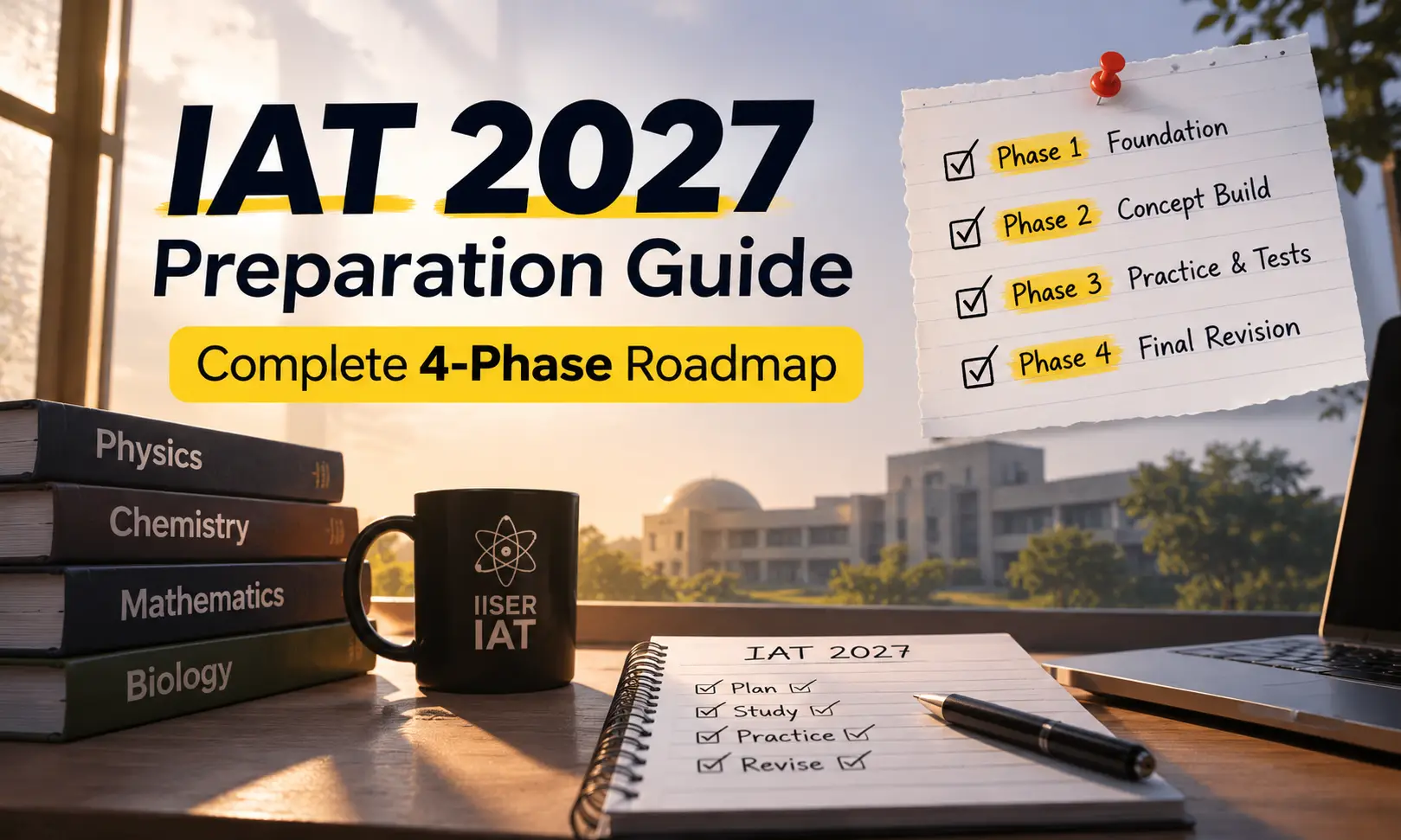
IAT 2027 Preparation Guide: 4-Phase Roadmap
Who This Guide Is For: Class 11, Class 12 and dropper students preparing for IAT 2027 who want one clear system to cover Physics, Chemistry, Mathematics and Biology without random study or burnout.
Pattern Used: Based on the recent IAT pattern. Always check the official IAT 2027 instructions when they are announced.
Learn, practise, analyse, improve. This guide gives you a simple system to prepare for the IISER Aptitude Test step by step, with a phase-wise roadmap, subject-wise NCERT chapter lists, a weekly study plan and the most common mistakes to avoid.
Understand the IAT First
The IISER Aptitude Test checks four subjects. You do not need to attempt every question, but you do need a balanced preparation.
| Feature | Details |
|---|---|
| Total MCQs | 60 |
| Questions per subject | 15 |
| Duration | 3 hours (computer-based) |
| Marking scheme | +4 / −1 |
Your preparation should follow one repeating cycle:
Learn → Practise → Analyse → Improve → Succeed
Three skills decide your result:
- Concept clarity: Know why a concept works, not just the formula.
- Application: Use concepts to solve unfamiliar, multi-step questions.
- Accuracy and time: Pick questions you can solve and leave the rest. A wrong answer costs a mark.
Your 4-Phase Roadmap
Phases are flexible. If you have finished most of the syllabus, spend more time on tests and revision. Use the checklists below to track your progress.
Phase 1: Concept Building and Syllabus Coverage
Goal: A strong foundation in all four subjects.
- [ ] Check the official syllabus
- [ ] List completed and pending chapters
- [ ] Study NCERT concepts systematically
- [ ] Solve basic questions after each topic
- [ ] Begin chapter-wise PYQ practice
Outcome: You know your strengths and weak areas.
Phase 2: Practice and Application
Goal: Solve exam-level questions.
- [ ] Increase chapter-wise PYQ practice
- [ ] Solve mixed-concept questions
- [ ] Attempt subject-wise tests
- [ ] Start and maintain your error log
Outcome: You apply concepts to unfamiliar questions.
Phase 3: Full-Length Tests and Improvement
Goal: Exam readiness.
- [ ] Take full-length mocks regularly
- [ ] Review every test properly
- [ ] Improve question selection and timing
- [ ] Revise weaker chapters alongside mocks
Outcome: A reliable approach for exam day.
Phase 4: Final Revision
Goal: Consolidate what you know.
- [ ] Revise key concepts and formulas
- [ ] Review your error log
- [ ] Reattempt difficult PYQs
- [ ] Avoid starting new resources late
Outcome: You enter the exam with a clear strategy.
Step 1: Build Concepts with NCERT
NCERT Class 11 and 12 is your base. The chapter lists below are guides, so always check the full official syllabus.
Physics
Key areas: Mechanics, Thermodynamics, Oscillations and Waves, Electrostatics, Current Electricity, Magnetism and EMI, Optics, Modern Physics.
Your approach: Understand the concept, derive or interpret the equations, solve basic numericals, then move to application questions.
Chemistry
Key areas: Mole Concept and Atomic Structure, Chemical Bonding, Thermodynamics, Chemical and Ionic Equilibrium, Electrochemistry, Chemical Kinetics, General Organic Chemistry, Hydrocarbons and Functional Groups, Coordination Compounds, Biomolecules.
Your approach: Mix concept learning with regular numericals, reaction revision and a steady review of inorganic facts.
Mathematics
Key areas: Functions and Trigonometry, Complex Numbers, Sequences and Series, Matrices and Determinants, Limits and Continuity, Differentiation and Integration, Probability, Vectors and 3D Geometry.
Your approach: Learn fundamentals, practise standard problems, then try questions that combine several concepts.
Biology
Key areas: Cell Biology, Plant and Human Physiology, Genetics and Molecular Biology, Evolution, Ecology, Biotechnology, Reproduction, Diversity of Living Organisms.
Your approach: Read NCERT carefully, revise diagrams and processes, and practise both factual and application questions.
PREP4IISER Support: Use the study materials, chapter-wise practice and video options in your programme. The goal is to solve questions independently.
The Method: Five Steps That Repeat
Step 1 is building concepts with NCERT (above). The next four steps repeat throughout your preparation.
Step 2: Prioritise Chapters
Use a tracker with five states: Not started, Learning, Practising, Needs revision, Strong. Weigh past-paper relevance, your current level and the time each chapter needs.
Tip: Trends help, but never skip a chapter in the syllabus.
Step 3: Make PYQs a Routine
Learn the chapter, solve its PYQs, analyse every mistake, then reattempt the hard ones. For every mistake, ask: was it a concept, formula, calculation, misread or slow method?
Step 4: Start Mocks Early
Go from chapter tests to subject tests to full-length mocks. Do not wait for the full syllabus to be complete.
Tip: Do not take mocks without setting aside time to analyse them.
Step 5: Analyse Every Mock
Your score shows where you are. Your analysis shows how to improve. Review your error log weekly. Each log entry should record the chapter, the reason for the mistake, the correct approach and a reattempt date.
Sort Every Mistake
| Mistake Type | Fix |
|---|---|
| Conceptual gap | Relearn the concept |
| Knowledge gap | Revise using active recall |
| Calculation error | Practise and check intermediate steps |
| Time-management error | Practise question selection and timed sets |
An Ideal Weekly Study Plan
This is an example for about 30–35 study hours a week. Consistency beats an unrealistic timetable.
| Activity | Hours per Week |
|---|---|
| Concept learning | 12 h |
| Chapter-wise practice | 8 h |
| PYQ practice | 5 h |
| Revision + error log | 4 h |
| Mocks + analysis | 4–6 h |
Daily Routine
- Session 1: Learn a new Physics or Chemistry topic
- Session 2: Practise Maths or Biology
- Session 3: Chapter questions and PYQs
- Session 4: Revise and review mistakes
Weekly Review
Ask yourself these questions every weekend:
- Which chapters did I finish?
- How many questions did I solve?
- What was hardest?
- Did my accuracy improve?
- What are my top 3 priorities next week?
Which Stage Are You In?
| You Are | Focus On |
|---|---|
| Class 11 | Strong foundations, questions after each chapter, regular revision |
| Class 12 | Balance boards and IAT, PYQs with chapters, revise Class 11, add timed tests |
| Dropper | Find why you lost marks, fix weak concepts, take mocks and review them |
| Limited time | Official syllabus, high-value topics, selected PYQs, avoid collecting resources |
Books and PREP4IISER Resources
You do not need every book. Keep NCERT, the syllabus, PYQs and revision at the centre of your preparation.
- Study materials: Organised notes across all four subjects.
- Chapter-wise PYQs: Practise questions right after each topic, with solutions.
- AIITS mock tests: Computer-based tests. Rankings and video solutions depend on your package.
- Videos and mentorship: Video lectures, solutions and doubt support, where included in your programme.
Reference books: H.C. Verma (Physics), N. Awasthi or M.S. Chauhan (Chemistry). Use them selectively. Check course details before enrolling.
You can explore the PREP4IISER Online Academy and the AIITS Test Series for structured practice.
Common Mistakes to Avoid
Studying without a plan
Ignoring NCERT fundamentals
Solving questions without reviewing them
Taking too many mocks
Neglecting a subject
Following every online strategy
Measuring success only by study hours
Relying only on predicted chapter weightage
Prepare with a Plan. Practise with Purpose.
Start with one chapter. Understand it, solve questions, learn from mistakes, revise, repeat. No platform can guarantee admission, but a steady system gets you closer.
Quick links: Visit PREP4IISER | Online Academy | AIITS Test Series
PREP4IISER: Empowering India's future scientists.