How to Get Under AIR 100 in IISER IAT 2026: The Complete Top Ranker Strategy
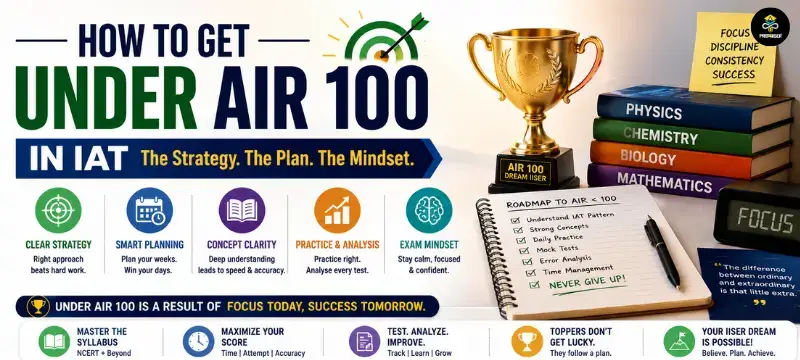
Who This Guide Is For: IISER IAT 2026 aspirants targeting a top 100 All India Rank (AIR). This guide assumes you have completed basic syllabus coverage and are now ready for rank-optimized preparation.
Prerequisite: Basic familiarity with Class 11-12 syllabus across Physics, Chemistry, Mathematics, and Biology.
Every IISER aspirant dreams of seeing a top rank on the result day.
But getting under AIR 100 in IISER IAT 2026 is not just about studying harder than everyone else.
It is about:
- Studying smarter
- Building exam intelligence
- Avoiding common mistakes
- Optimizing revision
- Mastering mock-test analysis
- Maintaining consistency for months
Most students preparing for IAT focus only on completing chapters.
Top rankers focus on:
- Accuracy
- Question selection
- Conceptual depth
- Retention
- Time efficiency
- Psychological stability
That is the real difference.
If your goal is AIR 100, you must prepare differently from the average aspirant.
This guide explains the exact mindset, strategy, and preparation system required to realistically target a top 100 rank in IISER IAT 2026.
What Does AIR 100 in IAT Actually Require?
An AIR under 100 generally demands:
- Exceptional conceptual clarity
- Very high accuracy (90 percent plus)
- Strong command over all four subjects
- Excellent mock-test performance (consistently top 200 in quality mocks)
- Consistent revision systems
- Low negative marking (2-3 incorrect attempts maximum)
The biggest misconception is that AIR 100 students solve every question.
They do not.
Top rankers usually win because they:
- Make fewer mistakes
- Avoid panic attempts
- Manage time efficiently
- Stay calm under pressure
The exam rewards precision more than reckless speed.
Key Reality Check: In IAT 2025, an AIR under 100 typically required approximately 190-210 marks out of 240, with accuracy above 85 percent. Every incorrect MCQ costs you not just 1 mark but also the opportunity cost of 4 marks you could have earned elsewhere.
Understanding the IISER IAT Exam Properly
Before discussing preparation, you must understand how the exam behaves.
IAT is not purely:
- JEE-oriented
- NEET-oriented
- Memory-based
- Formula-based
It is a highly analytical science aptitude examination.
Questions often combine:
- Multiple concepts
- Logical reasoning
- Scientific interpretation
- Elimination techniques
- Observation skills
This is why students who blindly memorize theory struggle during the actual paper.
IAT 2026 Exam Pattern at a Glance
| Feature | Detail |
|---|---|
| Total Questions | 60 MCQs + Numerical Type |
| Total Marks | 240 |
| Duration | 180 Minutes |
| Marking (MCQ) | +4 for correct, -1 for incorrect |
| Marking (Numerical) | +4 for correct, 0 for incorrect |
| Subjects | Physics, Chemistry, Mathematics, Biology (equal weightage) |
The Biggest Difference Between Average Students and AIR 100 Aspirants
| Average Aspirants | AIR 100 Aspirants |
|---|---|
| Consume content passively | Revise repeatedly |
| Keep changing resources | Analyze deeply |
| Ignore mistake analysis | Track mistakes systematically |
| Study randomly | Solve intentionally |
| Overestimate preparation | Focus on output, not study hours |
| Study until burnout | Maintain sustainable routines |
| Compare scores emotionally | Extract lessons from every mock |
The preparation style matters more than motivation.
The AIR 100 Preparation Roadmap
The ideal roadmap can be divided into four major phases.
| Phase | Duration | Primary Goal | Key Activities |
|---|---|---|---|
| Phase 1 | Months 1-2 | Build Elite Foundations | Deep conceptual understanding, basic problem solving |
| Phase 2 | Months 3-4 | Build Problem-Solving Intelligence | Speed, accuracy, question recognition |
| Phase 3 | Month 5 | Mock Test Domination | Timed practice, error analysis, stamina building |
| Phase 4 | Last 30 Days | Final Sprint | Retention optimization, confidence maintenance |
Phase 1: Build Elite Foundations (Months 1-2)
Primary Goal
Create extremely strong conceptual understanding.
Weak foundations cannot produce top ranks.
AIR 100 aspirants usually understand:
- Why formulas work
- How concepts connect
- When shortcuts fail
- How questions are framed
What You Must Prioritize
Physics
- Mechanics (Laws of Motion, Work-Energy, Rotational Dynamics)
- Thermodynamics and Kinetic Theory
- Waves and Simple Harmonic Motion
- Modern Physics (Photoelectric Effect, Atoms, Nuclei)
- Electrodynamics (Electrostatics, Current Electricity, Magnetism)
Chemistry
- Chemical Bonding and Molecular Structure
- Organic Mechanisms (GOC, Reaction Intermediates)
- Thermodynamics and Thermochemistry
- Ionic and Chemical Equilibrium
- Coordination Chemistry
Mathematics
- Calculus (Limits, Continuity, Differentiation, Integration)
- Algebra (Quadratic Equations, Complex Numbers, Matrices, Determinants)
- Coordinate Geometry (Straight Lines, Circles, Conic Sections)
- Probability and Statistics
- Trigonometry
Biology
- Genetics and Molecular Biology
- Human Physiology
- Ecology and Environment
- Biotechnology and its Applications
- Cell Biology
How AIR 100 Students Study Concepts
They do not simply read theory.
They:
- Learn concepts deeply from one trusted source
- Solve basic questions to test understanding
- Solve advanced variations from multiple sources
- Analyze every mistake without exception
- Revise repeatedly using spaced repetition
Concept mastery comes from repeated application, not passive reading.
Phase 2: Build Problem-Solving Intelligence (Months 3-4)
Primary Goal
Transform concepts into exam-level speed and accuracy.
This phase separates serious aspirants from casual learners.
The Most Important Skill: Question Recognition
AIR 100 students quickly recognize:
- Hidden patterns
- Repeated frameworks
- Shortcut opportunities
- Trap options
- Multi-concept combinations
This ability only develops through:
- Large-scale practice (1000+ quality questions per subject)
- Deep analysis of solution approaches
- Exposure to diverse question types
The Right Practice Strategy
Do not solve questions mechanically.
Instead:
- Time yourself for every problem set
- Mark difficult problems for later review
- Create error logs with mistake classification
- Reattempt failed questions without looking at solutions
- Compare multiple solution approaches for the same problem
Every mistake should teach something valuable.
Weekly Practice Targets for AIR 100
| Subject | Questions per Week | Focus Areas |
|---|---|---|
| Physics | 150-200 | Numerical problems, conceptual MCQs |
| Chemistry | 150-200 | Physical calculations, organic mechanisms, inorganic trends |
| Mathematics | 120-150 | Calculus, Algebra, Coordinate Geometry |
| Biology | 100-120 | NCERT-based MCQs, assertion-reason |
Phase 3: Mock Test Domination (Month 5)
Primary Goal
Turn preparation into rank-producing performance.
Mock tests are the single most important factor for AIR 100 preparation.
Many students study for months but never learn:
- Time management under pressure
- Pressure handling during difficult sections
- Accuracy optimization across subjects
- Intelligent skipping of time-consuming questions
Mocks teach all of these.
How Many Mock Tests Should You Attempt?
A serious AIR 100 aspirant should ideally complete:
- 20+ full-length mock tests under timed conditions
- 10-15 subject-wise sectional tests
- Previous 3-5 years of IAT papers (multiple times)
But the real secret is analysis.
The AIR 100 Mock Analysis Method
After every mock, classify every single mistake into four categories:
| Mistake Type | Meaning | Action Required |
|---|---|---|
| Conceptual Error | Concept not understood properly | Relearn the concept from basics |
| Silly Mistake | Avoidable calculation or reading error | Create a checklist to catch these |
| Time Management Error | Poor question selection or slow solving | Practice speed drills on weak topics |
| Risk Error | Unnecessary guessing that backfired | Learn when to skip and when to attempt |
This process improves rank dramatically within 5-6 mocks.
The 3-Step Post-Mock System
Step 1: Analyze Every Wrong Question
Understand exactly why the mistake happened. Write down the reason.
Step 2: Reattempt Without Solutions
After analysis, close the solution and reattempt the same questions. This rebuilds confidence and retention.
Step 3: Add Weak Areas to Revision Notebook
Your revision notebook should contain:
- Weak concepts requiring re-study
- Important formulas with derivations
- Repeated mistake patterns
- Smart shortcuts and elimination techniques
This notebook becomes extremely valuable in the last 30 days.
Mock Test Progress Tracker
| Mock Number | Raw Score | Accuracy | Silly Mistakes | Conceptual Gaps | Rank (if available) |
|---|---|---|---|---|---|
| Mock 1 | 150 | 70% | 8 | 5 | - |
| Mock 5 | 170 | 75% | 5 | 4 | - |
| Mock 10 | 185 | 80% | 3 | 3 | - |
| Mock 15 | 195 | 85% | 2 | 2 | - |
| Mock 20 | 205 | 88% | 1 | 1 | - |
Phase 4: Final AIR 100 Sprint (Last 30 Days)
Primary Goal
Maximize retention and maintain peak performance.
This phase is psychological as much as academic.
What You Should Do
- Revise your revision notebook daily
- Attempt 1 mock every 2-3 days (not daily)
- Focus on improving accuracy over speed
- Sleep 7-8 hours properly
- Avoid burnout through light exercise and breaks
- Build confidence through successful reattempts
What You Should NOT Do
- Start entirely new books or resources
- Study randomly without structure
- Panic after a bad mock (it happens to everyone)
- Compare scores constantly with others
- Change your successful strategy repeatedly
Stability matters greatly during the final month.
Last 30 Day Schedule Template
| Week | Focus | Mock Frequency | Revision Priority |
|---|---|---|---|
| Week 1 | Weak concept elimination | 2 mocks | High priority weak areas |
| Week 2 | Speed + accuracy balance | 2-3 mocks | Formula memorization |
| Week 3 | Full-length stamina building | 2 mocks | All subjects light revision |
| Week 4 | Confidence and relaxation | 1 mock (light) | Only revision notebook |
Subject-Wise AIR 100 Strategy
Physics Strategy for AIR 100
Physics is often the deciding subject for top ranks.
The best students focus on:
- Concept visualization through diagrams and real-world analogies
- Dimensional intuition to verify answers quickly
- Graph interpretation for kinematics and thermodynamics
- Logical derivations rather than formula mugging
Most Important Physics Areas
| Priority | Topic | Weight in IAT (Approx.) |
|---|---|---|
| High | Mechanics | 4-6 questions |
| High | Modern Physics | 3-4 questions |
| High | Electrodynamics | 4-5 questions |
| Medium | Thermodynamics | 2-3 questions |
| Medium | Optics | 2-3 questions |
| Low | Waves and SHM | 1-2 questions |
Physics Target
To realistically target AIR 100: Aim for 55+ marks out of 60 in Physics
Accuracy matters more than attempting every question. 14 correct out of 15 attempted is better than 16 correct out of 20 attempted.
Chemistry Strategy for AIR 100
Chemistry is the most scoring subject for many toppers.
Physical Chemistry
Treat it like mathematical problem solving. Focus on:
- Formula understanding and derivation
- Numerical practice with varied difficulty
- Fast calculation techniques (approximations, unit analysis)
Organic Chemistry
Focus heavily on:
- Mechanisms (SN1, SN2, E1, E2, Addition, Substitution)
- Reaction pathways and intermediates
- Carbocation and radical stability orders
- Functional group transformations
Inorganic Chemistry
Master:
- NCERT line by line (especially for p-block, d-block, coordination compounds)
- Periodic trends and exceptions
- Qualitative analysis
- Coordination compounds (naming, isomerism, bonding)
Chemistry Target
A strong AIR 100 aspirant should target: 60+ marks out of 60 in Chemistry
Chemistry is often the rank booster. Many AIR 100 students score 55-60 here.
Mathematics Strategy for AIR 100
Mathematics creates major rank separation in IAT.
Most students struggle because they memorize methods instead of understanding structures.
What AIR 100 Students Do Differently
They:
- Solve fewer but better quality questions
- Learn multiple approaches to the same problem
- Develop mathematical intuition rather than formula dependence
- Avoid unnecessary calculations by spotting patterns
Important Mathematics Chapters
| Priority | Topic | Key Subtopics |
|---|---|---|
| High | Calculus | Limits, Continuity, Differentiation, Integration, Area under curve |
| High | Algebra | Complex numbers, Quadratic equations, Matrices, Determinants, Sequences |
| High | Coordinate Geometry | Straight lines, Circles, Parabola, Ellipse, Hyperbola |
| Medium | Probability | Conditional probability, Bayes theorem, Distributions |
| Medium | Vectors and 3D | Dot product, Cross product, Lines and planes in space |
Mathematics Target
For AIR 100: Target 50-60 marks out of 60 in Mathematics
Mathematics has the steepest difficulty curve. Focus on accuracy first, speed second.
Biology Strategy for AIR 100
Biology is often ignored by PCM-focused students.
That is a strategic mistake.
Even moderate Biology performance can boost rank significantly. A PCM student scoring 40 in Biology gains a massive advantage over another PCM student scoring 20.
Key Biology Areas
| Priority | Topic | Why Important |
|---|---|---|
| High | Genetics (Mendelian, Molecular) | High weightage, conceptual questions |
| High | Human Physiology | Direct NCERT-based questions |
| High | Biotechnology | Application-based questions |
| Medium | Ecology | Factual, high-scoring |
| Medium | Cell Biology | Fundamental, frequently tested |
Biology Preparation Method
Focus on:
- NCERT mastery (read each line 3-4 times)
- Concept understanding over memorization
- Diagram interpretation and labeling practice
- Statement analysis for assertion-reason questions
Biology Target
A strong AIR 100 target: 50+ marks out of 60 in Biology
For PCM students, even 40+ is a strong advantage.
The Most Important Habit of AIR 100 Students
Consistency.
Not motivation. Not talent. Not intelligence alone.
Top rankers simply maintain:
- Better discipline
- Better systems
- Better revision
- Better analysis
for a longer duration than everyone else.
Motivation fades in weeks. Systems last for months.
The Ideal Daily Routine for AIR 100 Preparation
| Activity | Recommended Time | Best Time of Day |
|---|---|---|
| Concept Learning | 3-4 Hours | Morning (peak focus) |
| Question Practice | 3 Hours | Afternoon |
| Mock or Test Analysis | 1.5 Hours | Evening |
| Revision | 2 Hours | Night (before sleep for retention) |
| Breaks | 1-2 Hours | Distributed |
This structure creates long-term retention and exam efficiency.
Sample Daily Schedule
| Time | Activity |
|---|---|
| 6:00 AM - 7:00 AM | Wake up, light exercise, breakfast |
| 7:00 AM - 10:00 AM | Deep concept learning (one subject) |
| 10:00 AM - 10:30 AM | Break |
| 10:30 AM - 12:30 PM | Problem solving practice |
| 12:30 PM - 2:00 PM | Lunch and rest |
| 2:00 PM - 5:00 PM | Question practice continued or mock test |
| 5:00 PM - 6:00 PM | Break, walk, snacks |
| 6:00 PM - 7:30 PM | Mock analysis or mistake review |
| 7:30 PM - 8:30 PM | Dinner |
| 8:30 PM - 10:30 PM | Revision of yesterday's topics |
| 10:30 PM - 6:00 AM | Sleep |
How to Avoid Burnout During Preparation
Burnout destroys performance in the final months.
AIR 100 aspirants usually maintain:
- Proper sleep (7-8 hours is non-negotiable)
- Short breaks every 90 minutes of study
- Exercise or walking (30 minutes daily)
- Limited distractions (social media, phone)
- Structured weekly off (half-day rest)
A sustainable system always beats extreme short-term intensity.
Warning Signs of Burnout
- Difficulty concentrating during study sessions
- Irritability and frustration with small mistakes
- Physical fatigue despite adequate sleep
- Declining mock scores over multiple tests
- Procrastination and avoidance of difficult topics
If you notice these signs, take a full rest day immediately.
Common Mistakes That Prevent AIR 100
Mistake 1: Resource Addiction
Using too many books, YouTube channels, and test series creates confusion and shallow learning.
Solution: Master 1-2 high-quality resources per subject deeply.
Mistake 2: Ignoring Mock Analysis
Mock tests without thorough analysis produce very little improvement. The test is only 20 percent of learning. Analysis is 80 percent.
Solution: Spend 2-3x the mock duration on analysis.
Mistake 3: No Revision System
Without spaced revision, forgetting is inevitable. Human memory decays rapidly without reinforcement.
Solution: Implement the structured revision cycle below.
Mistake 4: Studying Passively
Watching lectures endlessly without solving questions is comfortable but ineffective.
Solution: Follow the 50-50 rule. 50 percent of study time on active problem solving.
Mistake 5: Panic Preparation
Constant stress destroys accuracy, decision-making, and health.
Solution: Trust your preparation system. One bad mock does not define your potential.
The AIR 100 Revision Formula
Use a structured revision cycle for every important topic:
| Revision Stage | Timing | Activity |
|---|---|---|
| Revision 1 | Within 24 Hours | Quick review of key formulas and concepts |
| Revision 2 | After 7 Days | Solve 5-10 problems on the topic |
| Revision 3 | After 30 Days | Full topic review with mixed questions |
| Revision 4 | Before exam | Revision notebook only |
This dramatically improves long-term retention from 20 percent to over 80 percent.
The Final 15-Day AIR 100 Checklist
Before the exam:
- [ ] Revise formulas and key concepts daily from revision notebook
- [ ] Solve previous year IAT papers under timed conditions (at least 3)
- [ ] Avoid starting new heavy chapters or resources
- [ ] Maintain consistent sleep schedule (7-8 hours)
- [ ] Focus on accuracy over speed in final mocks
- [ ] Stay calm and avoid comparing with peers
- [ ] Pack exam essentials (admit card, ID proof, photographs) 3 days before
- [ ] Visit exam centre location one day before to know travel time
- [ ] Stop studying by 6:00 PM on the day before exam
- [ ] Sleep early (by 10:00 PM) on exam eve
The final weeks should improve confidence, not create chaos.
Subject-Wise Marks to AIR 100 Mapping (IAT 2025 Reference)
Based on IAT 2025 trends, here is an approximate mapping:
| Subject | Target Marks for AIR 100 |
|---|---|
| Physics | 52-56 |
| Chemistry | 56-60 |
| Mathematics | 50-56 |
| Biology | 50-56 |
| Total | 208-228 out of 240 |
Note that cutoffs vary year to year based on paper difficulty and candidate pool.
Final Thoughts
Getting under AIR 100 in IISER IAT 2026 is difficult, but absolutely achievable.
The students who achieve top ranks are not always the smartest students.
They are usually the students who:
- Prepare strategically rather than hard
- Revise consistently using systems
- Analyze every mistake deeply
- Stay disciplined for months, not days
- Handle pressure intelligently
Your preparation system matters more than temporary motivation.
If you start building strong habits now and continue consistently for the coming months, AIR 100 is a realistic target.
The exam rewards clarity, discipline, and scientific thinking.
Stay consistent. Trust the process. Keep improving.
That is how top ranks are built.
Frequently Asked Questions
Is AIR 100 possible alongside JEE or NEET preparation?
How many mock tests are enough for AIR 100?
Is NCERT enough for AIR 100?
Which subject matters most for AIR 100?
How many hours should I study daily for AIR 100?
What is a good mock test score 30 days before IAT?
Should I attempt all 60 questions?
Can a PCM student score AIR 100 without Biology preparation?
Build Your Personalized AIR 100 Preparation Strategy
Every student has:
- Different strengths
- Different weaknesses
- Different preparation levels
A personalized preparation system always performs better than random studying.
Use structured mock tests, revision systems, analytics, and targeted practice to build a preparation strategy designed specifically for AIR 100 performance in IISER IAT 2026.
The earlier you start serious preparation, the greater your probability of securing a top rank.
Next Steps: Track your progress using the PREP4IISER IAT 2026 Score Calculator and Rank Predictor to estimate your current standing and identify improvement areas.